

Description
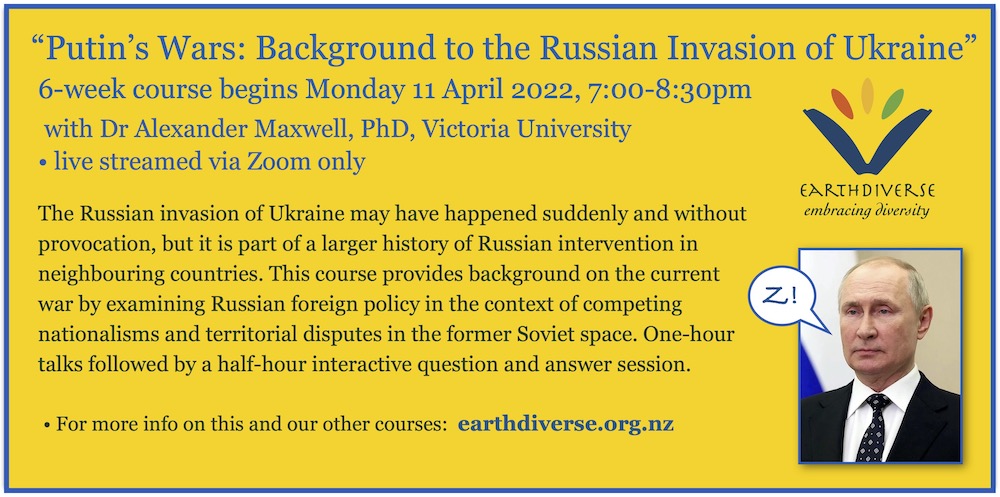
HIS330: PUTIN’S WARS: BACKGROUND TO THE RUSSIAN INVASION OF UKRAINE with Dr Alexander Maxwell, PhD, Victoria University of Wellington
Offered: begins Monday 11 April 2022
Day and Time: This course begins on Monday 11 April 2022, 7:00-8:30pm (NZ time), and meets for 6 consecutive weeks (including Easter Monday). The last session meets on Monday 16 May 2022. Some global equivalents:
-
- US Pacific Coast: Mondays 12:00am-1:30am
- US East Coast: Mondays 3:00am-4:30am
- London, UK: Mondays 7:00am-8:30am
- New Delhi, India: Mondays: 12:30pm-2:00pm
- Sydney, Australia: Mondays 5:00-6:30pm.
Location: due to the current Covid wave, this course is live-streamed via Zoom only and there is no in-person component.
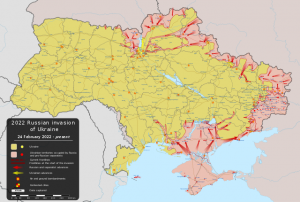
The Russian invasion of Ukraine may have happened suddenly and without provocation, but it is part of a larger history of Russian intervention in neighboring countries. This course seeks to provide background on the current war by examining Russian foreign policy in the context of competing nationalisms and territorial disputes in the former Soviet space. Lectures cover the collapse of the Soviet Union, the humiliation of post-soviet Russia, nationalist conflicts in Chechnya and Georgia, and Ukraine’s 2014 Maidan revolution. A final lecture will discuss the situation in Ukraine at the time of the lecture.
The covid pandemic means that this course will be delivered online and live-streamed via Zoom. This series of lectures will not be recorded or made available for later download. There are six lectures total, and there will be time after each lecture for discussion and questions.
COURSE OUTLINE:
Week 1 (11 April 2022): Putin and the Cold War:
This lecture outlines the society in which Putin was born and raised: the Soviet Union at the height of its power and influence. It describes the Soviet Union’s ethnic federalism, its empire in Eastern Europe, its technological achievements, and its increasing economic difficulties during the Brezhnev era. The lecture ends with Mikhail Gorbachev’s unsuccessful efforts to reform the Soviet economy, describing also Putin’s experience as a KGB agent in East Germany while the Soviet Empire in Eastern Europe fell apart.

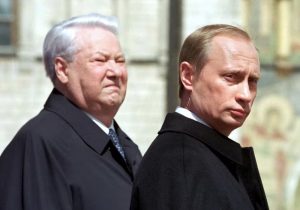
Week 2 (18 April 2022): Russia from Yeltsin to Putin:
This lecture begins with the 1991 coup that sparked the final dissolution of the USSR. It describes the era of Boris Yeltsin, its corruption, and the failure to reform the Russian economy. It also discusses the Russian communities stranded beyond the Russian frontier in the so-called “near abroad,” particularly emphasizing the conflict in Transnistria. It ends with Russian domestic policy under Putin: the curbing of oligarchs, the nationalization of the Russian energy sector, and the stifling of political dissent.
Week 3 (25 April 2022): The Chechen Wars:
This lecture describes the two Chechen Wars. It describes the Chechen Autonomous Republic in the context of the Caucasus and its complicated political geography. It summarizes the Chechen bid for independence under Dzhokhar Dudayev, and the radical Islamist movement that emerged after Dudayev’s death. It ends with Ramzan Kadyrov, his militia, and the pro-Putin government he runs in Chechnya.

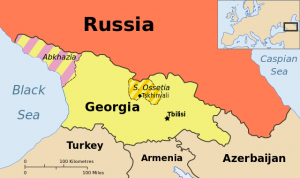
Week 4 (2 May 2022): War with Georgia: Ossetia and Abkhazia:
This lecture turns its attention to the southern Caucasus to outline Russia’s intervention in Armenian, Azeri, and above all Georgian politics. It traces Georgian politics from Zviad Gamsakhurdia’s ethnic purism, through Edvard Shevardnadze’s corruption, to Mikheil Saakashvili’s supposed pro-western reforms. It explains the status of Abkhazia, Adjaria and Southern Ossetia, describing how Saakashvili’s attempt to restore Georgian control over Southern Ossetia prompted a brief Russian invasion in 2008.
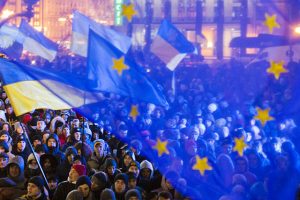
Week 5 (9 May 2022): Ukraine, Crimea and the Donbas:
This lecture traces Ukrainian history from the collapse of the Soviet Union. It describes Ukraine’s ethnic make-up, drawing particular attention to the phenomenon of Russian-speaking ethnic Ukrainians. It explains the Maidan revolution of 2013, the resulting crisis in Crimea, and how Russian intervention in Crimea encouraged separatism in the Donbas. The lecture ends with a description of the People’s Republics of Donetsk and Luhansk, and the abortive aspiration for “Novorossiya.”
Week 6 (16 May 2022): The 2022 Russian Invasion:
This lecture describes Putin’s justification for invading Ukraine in light of Ukrainian history. It will describe the progress of the war. The content of this lecture will respond to events as they unfold. There will be a lot of time for questions at the end.
Prerequisites: There are no prerequisites for this course.
Distance Learning: This course is offered as a live-streamed interactive Zoom session only. A Zoom Meeting ID will be sent to all who register for the course. Please note that this course will not be recorded.
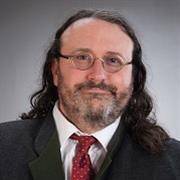
Dr Alexander Maxwell, PhD is an Associate Professor of History at Victoria University in Wellington, where he teaches, among other things, a course on Soviet history. He is the author of Choosing Slovakia, Patriots Against Fashion, and Everyday Nationalism in Hungary. He has published widely on nationalism theory, and the history of Eastern Europe. He is currently writing a book on Habsburg Panslavism.
DISTANCE-LEARNING OPTIONS:
This course is offered as a live-stream Zoom course only. Live-streaming allows you to participate fully in your own learning, ask questions of the instructor and participate fully in the same way as if you were in a physical classroom.
Please note that this course is not recorded and available only to be watched during the live-streamed sessions.
Detailed instructions on how to access our distance learning components will be sent after completing your registration. There are no additional fees for this service. However, distance learners will need access to a desktop or laptop computer with a good quality web-camera (tablet devices and mobile phones can also access our live-streamed classes), a built-in microphone (most modern laptops have built-in microphones) or a headset with a microphone. You may also need to download and install the free Zoom software on your computer or device.
- This course has no assignments, required readings, quizzes, tests or exams.
- All classes encourage questions and group discussion.
- There are no refunds for missed classes.
- Guests of registered participants are welcome to attend a single class at no charge.
Cost per person per Term (8 classes):
- Waged: NZ$125 (includes GST + online registration fee)
- Unwaged (unemployed, students, seniors): NZ$100 (includes GST + online registration fee)
Once registered, you will receive detailed instructions on how to access our courses via via Zoom.
DISTANCE LEARNING: live-streamed via Zoom only.


